Sunday, April 19, 2015
April 2015 : More Farmland
So once again, it has been almost a year since my last post. Similar to last year, it is not lack of activity that prevents me from posting, it has been another surge in activity. Last spring, while working on the newly acquired farmland, a real estate agent stopped and started a conversation with me. Never the conversationalist, and less so when I am operating a chain saw, my only memory of the conversation was another parcel would soon be offered for sale. Not intending to buy any more land, I forgot about this conversation for nearly six months.
But then I realized the land for sale was the more of the same prime Geauga County farmland that we already owned. Thankfully the seller and I were able to negotiate a deal and we worked together over the next four months to close the deal. Now we are the proud owners of an additional 10 acres (22 acres total) of historic farmland.
In recent years all the acreage has been leased to dairy farmers who have maintained an alfalfa / corn rotation. Some years the corn is harvested for grain and other years chopped for silage. Expecting the land to be re-purposed from farmland to housing at any moment, tenant farmers have not made any significant investments in the long term health of the soil.
Drawing on my years of experience building the health of neglected soils, I cobbled together a cover cropping strategy to nurse the soil back to health. The acidic pH and lack of organic matter prompted a decision I never thought I would (or even, could) make. My next posts will introduce the rusty iron equipment that have been given new life.
Sunday, June 29, 2014
June 2014 : Not Stalled Not At All!
Here is a photo of the raised beds, covered with black plastic mulch, transplanted to cantaloupes, with winter rye growing down the row middles. Completely by accident (maybe at this point, by habit) my previous photo was from the very same spot but it looked much different.
The previous photo showed raised beds with 100% surface disturbance which translates to 100% weed emergence. This photo proves I finally found a technique to lay the mulch, plant the cash crop and keep the cover crop. A flail mower is used to manage the cover crop residue. In addition to all the benefits the roots provide, when the winter rye is flailed, it thick residue will smother the soil surface.
Let's hope the cantaloupes go on to bear many fruits. The blossoms are out but I have not seen any bees.
Although it has been over a year since my last post, it is not lack of activity that prevented me from posting, it has been another surge in activity. Last spring, while researching farm transition plans, vacant land values, and appraisal methods, I noticed 12 acres of prime Geauga County farmland were for sale. Not the land I had intending to buy, but a great alternative if I couldnt buy the orchard that surrounds our current house.
Thankfully we were able to negotiate a deal and now are the proud owners of historic farmland. The land had been part of a dairy farm and crops alternated between alfalfa and corn. More recently the land had been leased to another dairy farmer who continued a similar rotation.
Thursday, May 9, 2013
May 2013 : Blossoms
Onions were transplanted a few weeks ago and have happily adjusted to life in the field. The first stand of sweet corn has been planted and so have beans and edamame although the dry weather may delay germination.
Rainfall is forecast for this week so that will encourage germination. It will also help put the finishing touches on the raised beds. Once the beds contain sufficient moisture I can make one pass with the rototiller to prepare a smooth bed then immediately cover with plastic mulch.
Monday, April 29, 2013
April 2013 : Twigs
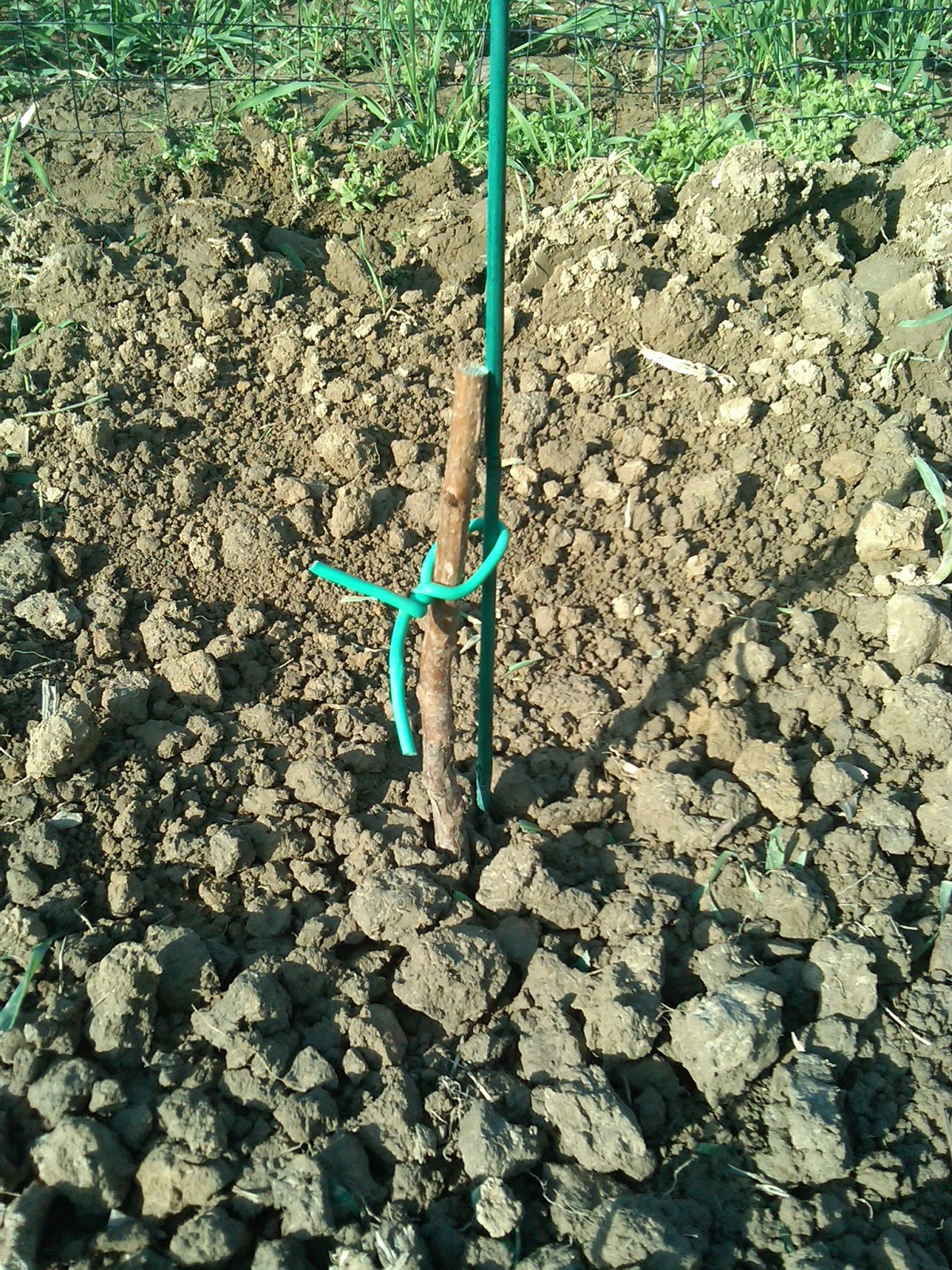
Here is a photo of a raspberry plant. Really. I understand the theory of planting dormant, bare root nursery stock. But Nathaniel asked why we were planting twigs. Normally we direct sow seeds or transplant green leafy plants with a root ball so this was a fair question. All the peat enriched soil is under the surface while the clumps are on the surface to prevent crusting. Eventually 4 - 6" of mulch will be added.
We planted 12 raspberry plants and 6 blueberry plants. The raspberries are the Heritage cultivar while the blueberries are Bluecrop, Patriot and Herbert culitvars. Heritage raspberries are ever-bearing which really means they can produce two crops a summer depending on pruning techniques. Blueberries need multiple cultivars for proper pollination and maximum fruit set. These cultivars also ripen early, mid and late season for a steady supply.
It will take at least two years for the twigs to establish and bear fruit. Even when these plants reach maximum bearing capacity there will never be sufficient harvest to take to market but plenty for the kids to eat. These plants are more for learning the art of pruning on a small scale before attempting to produce on a field scale.
Sunday, April 7, 2013
April 2013 : Field Work
Here is a photo of the tractor and the subsoiler engaging the soil. The subsoiler works to a depth of 24" but does not invert the soil. In fact, when performed properly, subsoiling barely disturbs the surface. Last year's mistakes inadvertantly proved the benefit of subsoiling to me.
Of all the mistakes I made, last year's biggest mistake was making passes 60" apart when passes should be 30" apart. In effect, half the field was subsoiled. Remember the hot, dry summer? The sweet corn stalks that grew over or close to the subsoiler passes were noticeably more vigorous than the stalks that grew between the passes.
Over the winter I also learned how to set up the three point hitch and adjust attachments. The hitch has several adjustments and the most important to a subsoiler is the angle of the tip. A properly angled tip will pull the attachment downward into the soil.
Another mistake I am willing to admit was over inflating the rear tires which reduced traction. Proper inflation of the rear tires is only 14 PSI. I inflated the rear tires to 36 PSI, which is the proper inflation of the front tires.
But correcting all those mistakes, this year subsoiling was performed, almost perfectly.
Saturday, February 23, 2013
February 2013 : yumions
This is a photo of our red onion transplants. Starting onions was different than starting our typical peppers and tomatos. Onions are started much earlier in the season and are started in smaller cell trays.
The transplants are ready for the field in 8 weeks from sowing. The onions are ready to be harvested 125 days later. Seeds that are sown in trays February 24 can be harvested August 24 under usual growing conditions. The trays contain 144 cells and each cell contains 3 seeds for a total of 432 seeds per tray.
That is an awful lot of tedious hand seeding! I was a bit annoyed performing this labor on a cold February night particularly when I realized we wouldnt be grilling these onions until Labor Day. But the yummy thought of red onions motivated me to finish.
Another month will pass before additional transplants are started. Thanks to the onions early start, all the necessary supplies have been replenished and all the starter trays and tools have been sterilized.
Monday, January 7, 2013
January 2013 - Closed
Here is a photo of the field ... all the vegetables harvested, plant debris flail mowed, soil subsoiled and seeded to winter rye cover crop. Now it's frozen and partially covered with snow. The cover crop was seeded later than ever - October 18 - but had sufficient germination and fair top growth.
I look at this photo and see the weed seed bank. Research has estimated up to 3,000 viable weed seeds exist in the top six inches of each square foot of soil. Our weed management practices have reduced but not eliminated that seed bank. We shall meet again ...
While planning the crops for this upcoming season, I have decided to try grafting some tomato plants. The concept is simple, start two tomato plants; one for good roots and one for good fruits. A few weeks after planting, cut the stem of each plant and use clips to hold the good roots bottom to the good fruits top. This technique is typically applied to heirlooms to improve plant vigor.
The bad news is my favorite heirloom seeds are becoming very scarce! I will fess up - at the end of a growing season, saving seed is at the bottom of my list. At that time, I gladly trade extra sleep then for couple extra dollars in seed packets later. The problem is that Nyagous seeds are surprisingly scarce.
Monday, October 8, 2012
Week of October 8 2012 : Oh Yeah!
Here is a photo of Francie eating a butternut squash. She was already done eating her dinner. But instead of whining for a dessert, she calmly walked to the serving dish, pulled up a chair, and continued eating the butternut.
This summer was somewhat different than previous summers.
Most everything was the same. We were busy watering and weeding. The plants looked healthy, the vegetables had great taste, and we worked late into the night to maintain the harvest. We went to bed certain beyond any doubt we put forth full effort.
But somehow this was easy. There was less stress. There was no strain. What was different?
Oh yeah, I forgot about the blog. I wasn't thinking about which photos to take, dreaming up catchy titles, or wondering if a topic was appropriate. And I wasn't hunched over a keyboard hoping I could translate thoughts into a post.
Freedom!
Now the down side is we didn't tell our story. We won't be able to share all the fun we had on the farm. How Francie got lost in the squash patch. Or how Nathaniel learned to prune a tomato plant.
Monday, July 30, 2012
Week of July 30 2012 : Thumper's Thumb
Determining the ripeness of some vegetables, like tomatoes, is rather easy. Others, like watermelons, are not as easy.
Watermelons are often purchased to be enjoyed as a dessert after a special family meal. The moment when that watermelon is first cut in half is a very deciding moment. Will the family enjoy a crunchy, juicy melon bursting with flavor? Or let out a collective moan?
That is why deciding when to take a fruit or vegetable can be stressful. The stakes are high as no grower wants to sell a watermelon with the 2" thick rind and pale pink interior.
Conventional wisdom says to thump a watermelon and listen for a hollow sound to determine if it is ripe.
However, "hollow" is not a precise measure. There are many tones of hollow, and not all indicate that perfect combination of crunch and flavor. The thump test may be accurate enough for watermelons that ripen as they are long-haul shipped.
But more accuracy is expected from farm market watermelons purchased directly from the growers. So how do we determine the perfectly ripe melon?
Vine condition is a good indicator. The little shoot (formally called a tendril) directly opposite the stem, will begin to whither. When the tendril is completely withered to the healthy vine then the watermelon is well on it's way to ripeness.
Bottom color is another good indicator. The surface that contacts the ground should be yellow.
Perhaps the most accurate indicator are worms! When worms cozy up to that yellow spot, that watermelon is ready to be enjoyed!
Monday, July 23, 2012
Week of July 23 2012 : Odds
Here is a photo of an Elmo-spotted toddler not-so-quietly sneaking through the rows of sweet corn. The most loveable of all critters, she is also one of the most destructive. But once I hear her joyous giggles as she runs up and down the rows discovering her foods of choice, I just dont want to stop her. Go, free range Francie, GO!
Agriculture departments at many universities publish research documents that classify certain events as likely to occur every year or possible to occur some years, or rare. This classification is useful to estimate the probability that an event will occur, and therefore, estimate the likelihood that a solution is necessary.
For example, powdery mildew on winter squash is an event that is likely to occur every year.
However, this year's hot and dry weather has certainly disrupted the typical events, for both better and worse.
One of the better disruptions has been the apparent impact on Japanese beetles.
These beetles have usually appear during the first week of July and made a disgusting nuisance of themselves for at least 6 weeks.
This year I scouted the first beetle on June 15, nearly 3 three weeks early, and I braced for the swarms that were sure to come. Several weeks later, the swarms still have not arrived. The ultimate Japanese beetle magnets, edamame plants, had only one leaf skeletonized and few nibbles on other leaves.
I am savoring this small victory and not at all wondering the effects on next year's generation.
Monday, July 16, 2012
Week of July 16 2012 : Orange
We have to be careful what we say at the dinner table. Anytime the word "tomato" is uttered, regardless of context, Nathaniel now yells "turtle speed!" and runs out to the tomatoes and picks a few more for his sister.
She likes to pick her own, too, but at first was somewhat confused. It took a few moments with the toddler-to-parent translator, but I finally realized she was asking "these apples, where tomatoes?"
She thought the towering tomato plants were actually apple trees. Oh to be so innocent. Once she realized they were in fact tomatoes, and learned where to find the ripe fruits, she can clear a cluster like a hornworm!
Monday, July 9, 2012
Week of July 9 2012 : Blossoms
Here is a photo of a pumpkin blossom. Squash generally have large, delicate and beautiful blossoms but these pumpkin blossoms are gorgeous! They measure over 6" in diameter and have a deep yellow almost orange color. Restaurants have offered as much as 40 cents per blossom ... maybe that is why they are so beautiful!
Flowering and pollination has always been a mesmerizing aspect of growing. Walking through any large field or orchard during active pollination is certainly a memorable experience. Bees buzz, no doubt, but thousands of bees buzzing almost shake the ground.
This year I approached pollination from another perspective though, because I needed to pollinate seedless watermelons. The challenge is that seedless watermelons cannot pollinate themselves. Typically special pollinator varieties are inter planted with the seedless varieties. The pollinators do not produce marketable watermelons but produce a lot of pollen for an extended period of time.
Being small scale growers we need to maximize our growing space and decided against the pollinators. Instead we chose to inter plant the seedless with seeded watermelons and time the plantings such that the flowering periods would overlap.
The theory has been proven viable although the timings were a few days off. The seeded reached peak blossom about five days before the seedless. Even so there was sufficient overlap to get good set on the seedless.
Another oddity of seedless watermelons is the vines grow continuously throughout the season. Seeded watermelons have vegetative and reproductive phases; vines stop growing during the reproductive phase. But seedless have a vegetative phase only.
Monday, July 2, 2012
Weef of July 2 2012 : Lost
Here is a photo of Nathaniel inspecting the portable greenhouse and looking for his cabbage. As the saying goes, be careful what you wish for because you may get it. Everybody I know was wishing for rain.
We sure got it, and with it came the complimentary high winds.
Anytime the forecast calls for winds greater than 30 mph I simply roll the greenhouse into the garage. On this fateful day the weather forecast called for sustained winds between 15 - 20 mph.
After the storm rolled through I instinctively went outside to estimate how much rain fell. Soon I noticed the tell tale signs of high winds then noticed the street lights were not casting the usual shadows across the driveway. But the street lights were on. So what was missing?
Uh Oh. It took me a few moments to remember the greenhouse and all it's transplants growing for the fall.
Greenhouses don't just disappear but they can blow a long distance.
Although we lost the first wave of all the fall transplants, the second wave has been sowed and is off to a good start.
Monday, June 25, 2012
Week of June 25 : Bees at Work
Here is a photo of the result of the honey bees hard work. The bees were working the cantaloupes then switched rows and began to work the watermelons. This is a Sugar Baby, which is the classic red seeded ice box variety. The growing conditions this year havent been particularly favorable for most crops but the melons are sure loving it!
Sunday, June 24, 2012
Week of June 18 2012 : Bees. BEES!
Here is a photo of a bee. A real, and hard working, bee! There are many bees working the blossoms this week. This particular bee is working the rows of cantaloupes. His hive friends are nearby working the watermelons.
Part of successful farming is timing. We won't say how much of good timing is hard thinking and how much is blind luck because proper strategy is easily negated by the weather.
One of my habits as a grower was to start transplants too early. My attempt to get plants to set fruit early actually back fired and caused them to set fruit later. Just as the plants were accepting a life of being root bound in a tiny flat and begrudgingly beginning the reproductive phase, I would then set it out in the field. Excitedly the plant would shift back to vegetative phase for a few more weeks before shifting back to reproductive phase.
This year I intentionally started the plants later. It was a hard habit to break. But the timing has worked out much better. The plants have not had to waste time shifting between phases; as a result the plants reached vegetative maturity earlier and are now in reproductive phase.
Sure the heat helps the plants grow and encourages the bees to work a full day. Combine better timing with great conditions and cantaloupes have set fruit about 3 weeks early.
Hopefully our watermelons share this same wonderful experience.
Saturday, June 16, 2012
Week of June 11 2012 : Extras
Here is a photo of Nathaniel and Francie looking at the extra transplants. They are discussing and deciding which seedlings they want to transplant. Nathaniel is well prepared with his green shovel. They chose two cantaloupes and further decided the best location was in their sandbox. It's great to share the experience.
All the spring transplanting and direct seeding is finally done. The eggplants, peppers and tomatoes were transplanted about three weeks ago and are already setting fruit. The cantaloupes and watermelons were transplanted about a week ago and are already vining. The transplants has been unaffected by the dry weather. In fact, they are thriving in the heat.
The direct seeded plants are more of a challenge. The dry soil has hampered germination, although we have taken measures to counteract the conditions. During seeding, we incorporate vermiculite into the soil to minimize soil crusting. Then we laboriously hand water until the seeds germinate. This technique has produced great results.
Next up is the fifth and final stand of sweet corn. Four stands have been planted, emerged, and are in various stages of growth. Once that stand is planted, then its back to the greenhouse to start the fall transplants!
Friday, June 1, 2012
May 2012 : Capital Improvements
There is a specific passage about Bear growling to protect his tomatoes. Nathaniel decided his role is the bear, so he is empowered to growl at me. Logic doesnt get too far with toddlers, so I dont bother explaining that I cannot be stealing his tomatoes because young transplants dont have tomatoes.
This was the spring I learned another valuable lesson. I will never say I am busy, ever again.
This year I decided on another significant capital improvement. Fencing the entire field. This meant removing the existing fence and installing the new fence. Easy enough.
But just as I was pulling the last corner post, my wife walks outside with a slow but purposeful stride. I have seen this stride before. A life changing conversation was coming my way.
The following exchange confirmed my suspicions, that our third farm hand was in the early stages of development. Great! Except for the wicked morning sickness that soon followed. Morning sickness is not limited to mornings; afternoons, evenings and night times are equal opportunities for sickness.
I soon took on additional responsibilities around the house, from laundry and dishes to being the first responder to every middle-of-the-night yelp. That and the full time plus, off the farm job kept me moving and tired.
Factor in the fencing project. Moving faster and very tired.
Now factor in the starting seedlings, shaping beds, laying irrigation and laying mulch.
Somehow I survived these loong days.
The fence is up and the majority of the early season work is done, all on schedule.
Now we can relax and watch it all grow.
Sunday, April 29, 2012
April 2012 : Broccoli
Here is a photo of Nathaniel posing with his broccoli. For some unexplainable reason, he loves fresh cabbage. I lured him into the garden by promising he could help me transplant the cabbage. And we did, but I never mentioned when we finished transplanting the cabbage and started the broccoli. Surprisingly he injured none of the plants. His sister, though, was busy trying to eat the leaves.
Here is another photo of the broccoli, nighttime with the dew glistening in the flash photo.
April was a busy month as usual. In addition to the usual pre-season tasks, greenhouse tasks, and field tasks, we participated in a Good Agricultural Practices training seminar. This seminar focuses on food safety and covers the time period from field preparation through the point of sale. That is a long period of time and there are many threats along the way!
All topics were interesting but one topic was almost startling. How many people reuse containers? Vendors reuse containers while measuring pints and quarts. Customers reuse shopping bags to carry produce from market to home. Both practices are intended to be environment friendly but violate good agricultural practices!
Reusing containers and bags increases the likelihood of surface contamination. For example, produce such as berries or tomatoes can easily be damaged thus contaminating container surfaces. Bacteria has a place to grow during the week between markets.
Reusing containers and bags also complicates tracing product's history. Another example, when a bag is the source of contamination, did it get contaminated at today's market? Or was it contaminated weeks ago at the grocery store when it was set on the parking lot ground while searching for the car keys?
Ultimately food safety is everyone's responsbility. The GAP training identified several similar scenarios as well as practices and techniques to minimize the risk.
Friday, March 30, 2012
March 2012 : Subsoiling

Here is a photo of Francie sitting in a field. She is thoroughly upset. Where is the broccoli?
My first attempt at subsoiling was somewhat of a bust. Proper subsoiling fractures the soil to a depth of upto 24". The surface is minimally disturbed and certainly the soil is not inverted. This technique requires big horsepower to reach maximum depth and maintain high speeds.
In my thought experiments I knew I would not be able to maintain both depth and speed so I opted to maintain speed to achieve the desired fracturing action. Multiple passes would be necessary to fracture to the proper depth.
Two variables I had not anticipated. Shallow subsoiling, particularly with a well rooted winter rye cover crop, forms large clods. The surface was more than minimally disturbed. These clods forced the second pass to be completed at slower speeds. The soil was not completely fractured to the desired depth.
So my first subsoil experience was less than perfect. But the field conditions are better than before I started. The shallow hardpan is certainly gone. And revving and roaring a tractor with a ground engaging attachment was certainly a thrill.
Saturday, February 11, 2012
February 2012 : Subsoiler

Here is a photo of our new ripper. It's a rather rugged piece of equipment weighing in at 248 pounds. It has a 24" working depth and will shatter hard panned soil. Usually these implements are known as subsoilers but this also rips tree roots. Yikes, hence the name, ripper.
Soil health has always been a passion of mine and I have read several books on the topic. My favorite book is Building Soil for Better Crops. Once our soil was limed to the appropriate pH to the appropriate depth we minimized our tillage practices. We plow occassionally to make raised beds and turn under cash crop or cover crop residues but work the soil as little as possible.
But about 12" beneath the surface there has always been significant soil compaction. This was the year we vowed to correct this final soil deficiency.
So off to Earth Tools website I went, happy I would finally buy another implement, a subsoiler, for our beloved two wheel tractor. But I was greeted by a note that the subsoilers were temporarily unavailable to fit BCS -- undergoing redesign.
That started me on a detour that, well, let's just say, was the scenic route. Three months later we have a subsoiler and then some. We also have a new-to-us four wheel tractor.
Subscribe to:
Posts (Atom)