Sunday, June 27, 2010

Week of June 28 2010 : Harvest


(Here is a (sideways) picture of our Hansel eggplant which is similar to the famous Lady Finger. This is our first growing experience with eggplant and are pleased with the results. The plants are beautiful with big leaves and delicate purple blossoms. Thorns attempt to protect the blossom and fruit from predation. The fruits are small, optimal size is 4" - 5"; they are thin skinned and are non-bitter. Unfortunately these plants also present a management challenge: Japanese beetles prefer these eggplant over edamame.)

So far this season there have been harvests in many senses of the word.

Of course we are harvesting vegetables. We planned our first day at the Geauga Fresh Farmer's Market to be July 17. The warm weather is certainly helping us meet that goal. We are already harvesting cucumbers, eggplant, snap peas and summer squash. No surprises there. We also have harvested a few peppers and tomatoes and anticipate several more varieties will mature in time for first market. Again, no surprises.

The big surprises are the cantaloupes and watermelons! The bees are busy working the blossoms and their work has produced a wonderful fruit set and may (though doubtful) have maturity in time for first market. Go melons!

We are also "harvesting" a lot of birds. Five Blue Birds fledged from our Peterson nesting box and the parents are already building their second nest. Five Tree Swallows fledged from our NABS nesting box. Robins have fledged two broods from their undersized nest on our front porch. And we have Purple Martins nesting in our garage; there are at least five, as many as seven, hatchlings.

And the other "harvest", we welcomed our baby daughter to the world.

Week of June 21 2010 : The Slide.


(I know, here is YET ANOTHER picture of our first stand of sweet corn. This is a close up of the silks. We nick named this Muppet Corn because the silks have a purple tint. These silks, contrasted with the dark green leaves, look really great in the field. I am sure our future market customers will agree the ears will taste just as great.)

Most of our back yard is cultivated. There is not much room for playing and there is less room for large children's toys like slides or pools. So when we acquired a slide / swing combo and a splash pool, we had to consider where to put it all. After strategic deliberations, we decided to put it near the pea patch.

Now that the peas are mature, we see just how wonderful that idea was. After a hard slide, our son lands then runs a few steps to the peas. He harvests a pod from the plant, crunches the peas and giggles as he runs back to the beginning of the slide to repeat the fun.

And hot days in the pool are even better. We help him harvest a handful then he sits in the cool water crunching away and giggling. This time last year he was still eating strained peas from a jar. We laugh and tell him this is the good food. He screams, YEAH YEAH, excitement mixed with bitterness, which means he never forgot the strained pea experience.

Unfortunately, the fresh snap peas probably will never make it to market. The warmer weather hastened the maturity and our anticipated market start date is July 17. The timing may not work out but witnessing a person so excited about humble snap peas reminds us why we farm for market.

Friday, June 18, 2010

Week of June 14 2010 : Blossoms, fruits and tassels.


(Here is a picture of a Satsuma sweet bell pepper. This is an orange pepper with the traditional four lobe pepper shape. Of course it has thick crunchy walls so it will add color, texture and flavor to any dish. The plant in the foreground is a victim of sunset photography; the flash causes the plant to look chlorotic but is healthy.)


Wednesday night was a very casual night. We were caught up on transplanting, pruning and trellising and there were no disease or fungus threats. So we casually toured the fields to review our hard work.

Since the recent days have been perfect growing weather, and the night time temperatures have remained unusually warm, we are accumulating growing degree days quite rapidly. This translates to early blossoms and fruit set. We were expecting to see fascinating things and we were not disappointed.

Not surprisingly, the snap peas and zucchini are already setting fruit.

The cucumbers, eggplants, peppers and tomatoes are also setting fruit. Usually the first tomato clusters have blossom end scarring known as cat facing; but the warm nights have allowed the plants to set fruits that are blemish free. Even the late season heirlooms, which are notorious for disappointing first fruit set, have set clean clusters.

The cantaloupes and watermelons are also in blossom but we have yet to scout any significant fruit set. Watermelons are such a fickle plant. During the seedling stage they are very sensitive to temperature; any variation will stunt growth. The seedlings do not have thick fibrous root ball so transplanting must be done very carefully otherwise the transplant shock will also stunt growth. Next year I will line the plug trays with Jiffy peat pots.

Of course we need to give some press to our sweet corn too. The corn is beginning to tassel! So much for the old adage, knee high by the fourth of July. This corn will be silking by the fourth of July. Last night we planted our sixth stand; still two more stands to plant.

Yeah for healthy plants. And yeah for healthy food!

Sunday, June 13, 2010

Week of June 7 : Correction


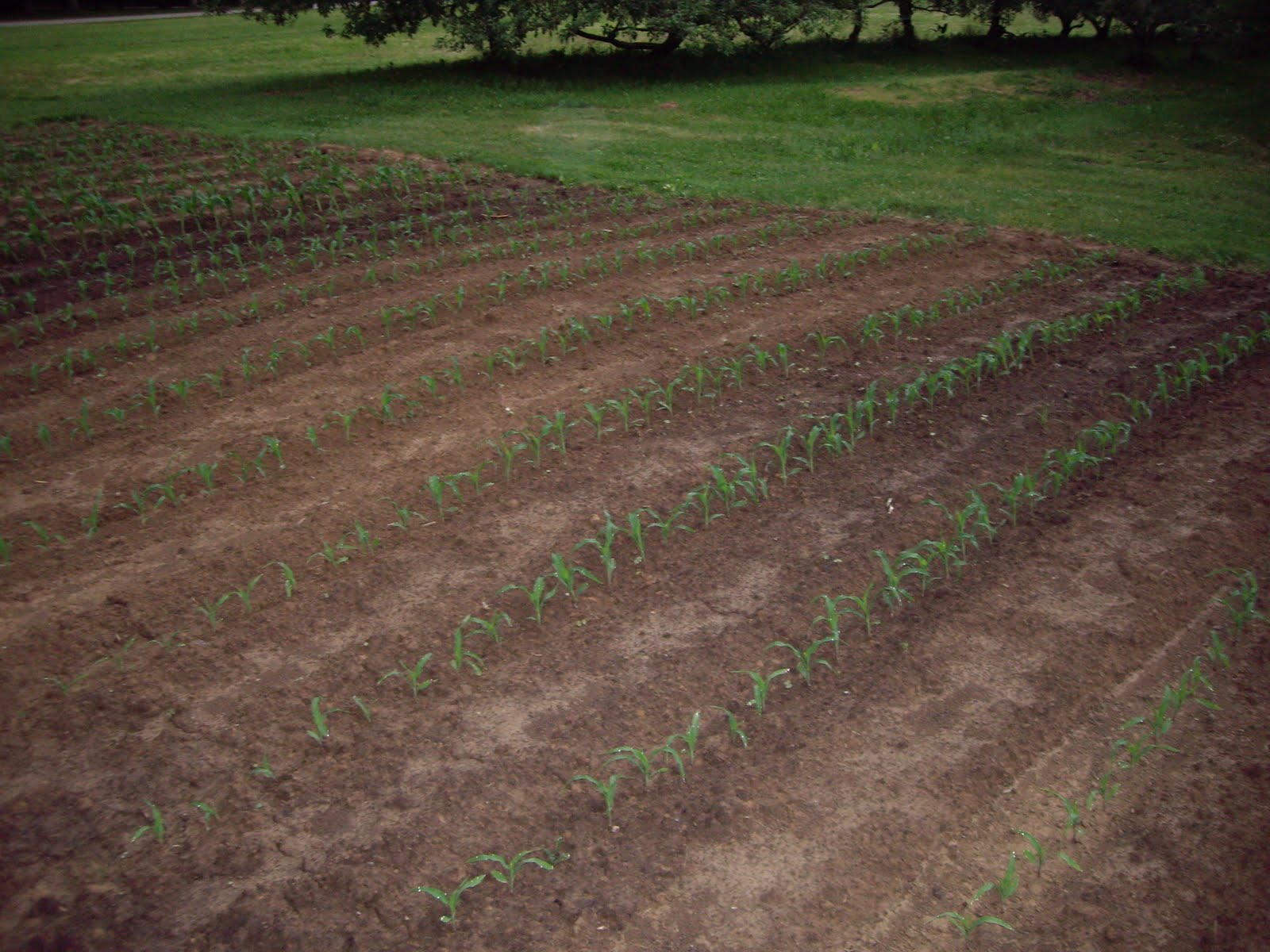
(Here is a picture of our first stand of corn. This corn has suffered frost damage, hail damage and wind damage. But it has survived each threat. The target harvest date is July 23 but with the warmer than expected weather this stand may be harvested sooner.)

My last comment, let it grow, was true but not the complete truth. While we did catch up on the transplanting that was not the end of the sowing. Ahh, and it was just the beginning of all the maintenance!

We need to accept a fact: we will never be done with all the maintenance.

There will always be more weeds. There will always be more bugs. There will always be more pruning and training. There will always be more threats of disease. My neighbor once gave me sage advice, harvesting a clean crop is both a physical and mental challenge.

Farming is well known to be physically demanding. But mentally challenging? Anticipating the threats and prioritizing those threats certainly requires knowledge and foresight. Discipline is also necessary.

Consider how many crops we are growing (14), how varieties (39) and how many stands (as many as 8 per crop). Just organizing the sowing schedule is challenging for me! Only now comes the physical labor.

Wednesday, June 2, 2010

Week of May 30 2010 : Push!


(Here is a picture of our Diva cucumbers. These feature a smooth, thin and no-peel skin. They are tender, crisp, sweet and seedless. Because they are a non-bitter variety they are much less attractive to cucumber beetles.)


The big push is over. During the winter months we carefully prepared a complete schedule of tasks, ranging from starting seedlings, to preparing the fields, to setting the transplants. Of course we expected some interference from the weather so the real intent of the schedule was not to define deadline dates but rather to assign an order and priority to all the tasks. The schedule was constructed such that, if the weather would just somewhat cooperate, we could complete a few tasks each day and avoid a major push.

So much for weather cooperation. So much for the schedule. We were left with nothing but a BIG push. Things had to get done. That meant putting fresh batteries into the head lamp and setting transplants until 10:30 PM. Then waking up the next day at 4:30 AM to continue setting transplants. But things got done.

Now its time to step back and let it grow!

Thursday, May 27, 2010

Week of May 24 2010 : Busy


(Here is a picture of Moon & Stars watermelon seedlings. The red fleshed variety is common but this is a less common yellow fleshed variety. Both the red and yellow fleshed varieties sport the same foliage. Interestingly that foliage is spotted! The spots are expected and not a nutritional deficiency or disease.)


The blue birds have hatched. The nest contained five eggs and all five successfully hatched. Lets hope the success continues and all five fledge in about eighteen days.

The North and South fields have been completely prepared. The raised beds have been formed, the irrigation trickle lines have been laid, and the plastic mulch rolled out. Forming the raised beds with the rotary plow was easier and quicker than I anticipated. That was a nice surprise! Working from the right edge of the field to the left, I simply made one clockwise pass around the edge of each bed. Done.

Now transplanting is furiously in process.
Suddenly I remembered the joy of direct sowing.

The first beans have been sowed. We are growing green, yellow and purple snap beans. The beans we are most excited about, though, are the soy beans. These are a 100 day crop so there is still a lot of time to anticipate those sweet beans.

Monday, May 24, 2010

Week of May 17 2010 : Soggy


(Here is a picture of our second stand of sweet corn. The first stand was damaged but not destroyed by the freeze. This stand was also were able to withstand several waves of thunder storms including hail. The third and fourth stands have been planted and are already emerging.)


Its a well known fact that the market farmer bylaws mandate lamenting the early season weather. In April, we had record highs. Earlier in May, we had a very low, low. Here in the valley we bottomed out at 27 degrees. That is not a frost, that is a freeze.

The cold weather was soon followed up with significant rainfall. In a few days we went from below average moisture to above average moisture. The problem? Remember the nicely plowed fields? Apparently primary tillage acts like a big sponge in a big tub. Nice absorbent soil in the middle of hard pan.

Now field work has been excessively delayed. We still need to form the raised beds. Which means we still need to lay the trickle irrigation lines and the plastic mulch. Which means we still need to transplant. So we have been busy watering and shuffling seedlings in and out of the garage. In an effort to minimize unnecessary labor, the garage door has been open more often.

Which produced an odd side effect, now we have a pair of purple martins nesting in our garage. Quick recap, we went from a rotary plow to a bird nest. The connection is obvious? (No).

In a sense, farming is like a game of chess. The grand masters must think several moves ahead. In farming, though, the impact is much less direct.