Monday, April 29, 2013

April 2013 : Twigs


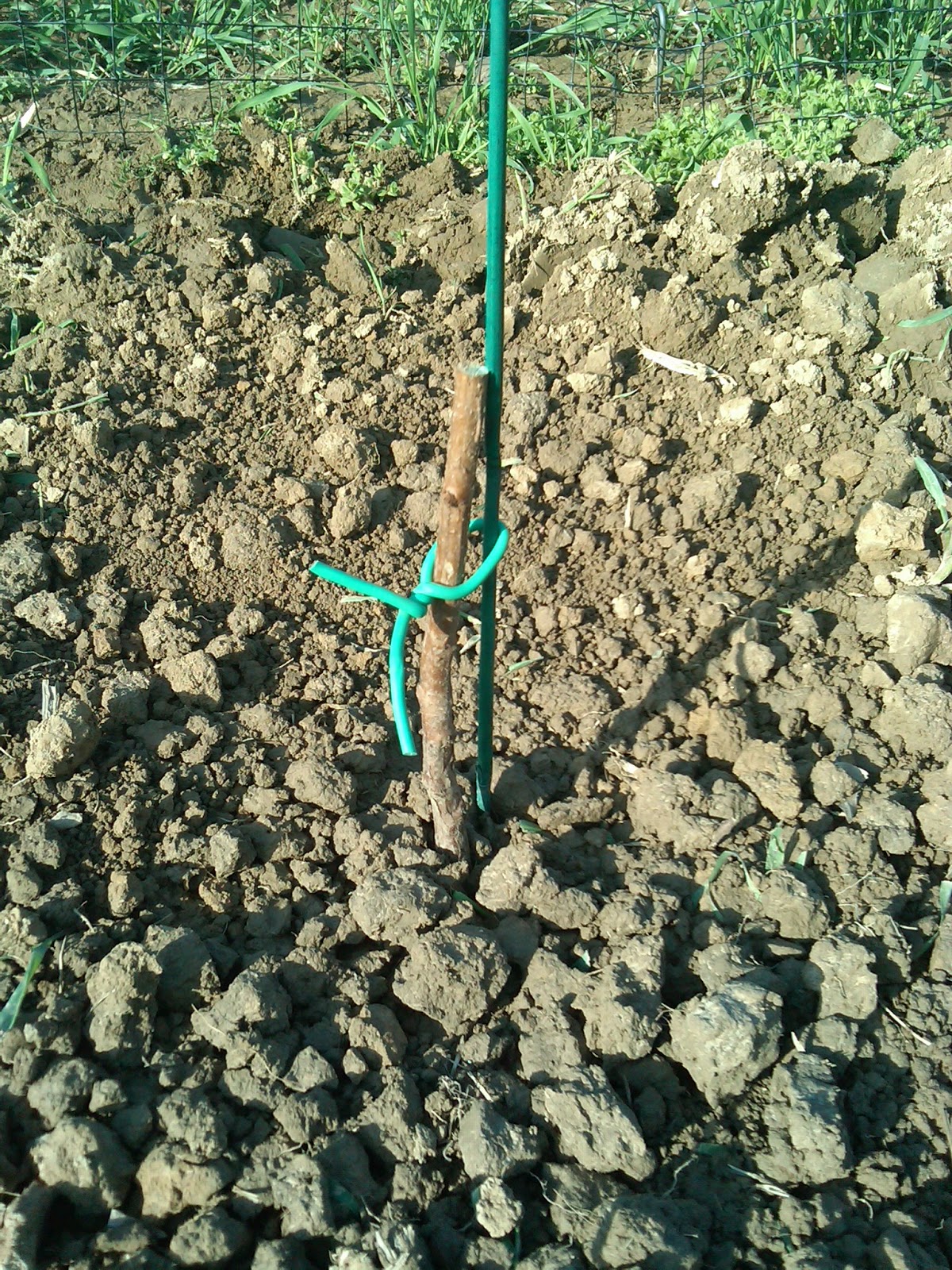
Here is a photo of a raspberry plant.  Really.  I understand the theory of planting dormant, bare root nursery stock.  But Nathaniel asked why we were planting twigs.  Normally we direct sow seeds or transplant green leafy plants with a root ball so this was a fair question.  All the peat enriched soil is under the surface while the clumps are on the surface to prevent crusting.  Eventually 4 - 6" of mulch will be added.

We planted 12 raspberry plants and 6 blueberry plants.  The raspberries are the Heritage cultivar while the blueberries are Bluecrop, Patriot and Herbert culitvars.  Heritage raspberries are ever-bearing which really means they can produce two crops a summer depending on pruning techniques.  Blueberries need multiple cultivars for proper pollination and maximum fruit set.  These cultivars also ripen early, mid and late season for a steady supply.

It will take at least two years for the twigs to establish and bear fruit.  Even when these plants reach maximum bearing capacity there will never be sufficient harvest to take to market but plenty for the kids to eat.  These plants are more for learning the art of pruning on a small scale before attempting to produce on a field scale.

Sunday, April 7, 2013

April 2013 : Field Work


Here is a photo of the tractor and the subsoiler engaging the soil.  The subsoiler works to a depth of 24" but does not invert the soil.  In fact, when performed properly, subsoiling barely disturbs the surface. Last year's mistakes inadvertantly proved the benefit of subsoiling to me.

Of all the mistakes I made, last year's biggest mistake was making passes 60" apart when passes should be 30" apart.  In effect, half the field was subsoiled.  Remember the hot, dry summer?  The sweet corn stalks that grew over or close to the subsoiler passes were noticeably more vigorous than the stalks that grew between the passes.

Over the winter I also learned how to set up the three point hitch and adjust attachments.  The hitch has several adjustments and the most important to a subsoiler is the angle of the tip.  A properly angled tip will pull the attachment downward into the soil.

Another mistake I am willing to admit was over inflating the rear tires which reduced traction.  Proper inflation of the rear tires is only 14 PSI.  I inflated the rear tires to 36 PSI, which is the proper inflation of the front tires.

But correcting all those mistakes, this year subsoiling was performed, almost perfectly.

Saturday, February 23, 2013

February 2013 : yumions


This is a photo of our red onion transplants.  Starting onions was different than starting our typical peppers and tomatos.  Onions are started much earlier in the season and are started in smaller cell trays.

The transplants are ready for the field in 8 weeks from sowing.  The onions are ready to be harvested 125 days later.  Seeds that are sown in trays February 24 can be harvested August 24 under usual growing conditions.  The trays contain 144 cells and each cell contains 3 seeds for a total of 432 seeds per tray.

That is an awful lot of tedious hand seeding!  I was a bit annoyed performing this labor on a cold February night particularly when I realized we wouldnt be grilling these onions until Labor Day.  But the yummy thought of red onions motivated me to finish.

Another month will pass before additional transplants are started.  Thanks to the onions early start, all the necessary supplies have been replenished and all the starter trays and tools have been sterilized.

Monday, January 7, 2013

January 2013 - Closed


Here is a photo of the field ... all the vegetables harvested, plant debris flail mowed, soil subsoiled and seeded to winter rye cover crop.  Now it's frozen and partially covered with snow.  The cover crop was seeded later than ever - October 18 - but had sufficient germination and fair top growth.

I look at this photo and see the weed seed bank.  Research has estimated up to 3,000 viable weed seeds exist in the top six inches of each square foot of soil.  Our weed management practices have reduced but not eliminated that seed bank.  We shall meet again ...

While planning the crops for this upcoming season, I have decided to try grafting some tomato plants.  The concept is simple, start two tomato plants; one for good roots and one for good fruits.  A few weeks after planting, cut the stem of each plant and use clips to hold the good roots bottom to the good fruits top.  This technique is typically applied to heirlooms to improve plant vigor.

The bad news is my favorite heirloom seeds are becoming very scarce!  I will fess up - at the end of a growing season, saving seed is at the bottom of my list.  At that time, I gladly trade extra sleep then for couple extra dollars in seed packets later.  The problem is that Nyagous seeds are surprisingly scarce.

Monday, October 8, 2012

Week of October 8 2012 : Oh Yeah!


Here is a photo of Francie eating a butternut squash.  She was already done eating her dinner.  But instead of whining for a dessert, she calmly walked to the serving dish, pulled up a chair, and continued eating the butternut.

This summer was somewhat different than previous summers.

Most everything was the same.  We were busy watering and weeding.  The plants looked healthy, the vegetables had great taste, and we worked late into the night to maintain the harvest.  We went to bed certain beyond any doubt we put forth full effort.

But somehow this was easy.  There was less stress.  There was no strain.  What was different?

Oh yeah, I forgot about the blog.  I wasn't thinking about which photos to take, dreaming up catchy titles, or wondering if a topic was appropriate.  And I wasn't hunched over a keyboard hoping I could translate thoughts into a post.

Freedom!

Now the down side is we didn't tell our story.  We won't be able to share all the fun we had on the farm.  How Francie got lost in the squash patch.  Or how Nathaniel learned to prune a tomato plant.

Monday, July 30, 2012

Week of July 30 2012 : Thumper's Thumb


One of the stressful aspects of growing is harvesting the fruits and vegetables. Growing is hard work, but all the work could be for naught if harvesting is too early or too late.

Determining the ripeness of some vegetables, like tomatoes, is rather easy. Others, like watermelons, are not as easy.

Watermelons are often purchased to be enjoyed as a dessert after a special family meal. The moment when that watermelon is first cut in half is a very deciding moment. Will the family enjoy a crunchy, juicy melon bursting with flavor? Or let out a collective moan?

That is why deciding when to take a fruit or vegetable can be stressful. The stakes are high as no grower wants to sell a watermelon with the 2" thick rind and pale pink interior.

Conventional wisdom says to thump a watermelon and listen for a hollow sound to determine if it is ripe.

However, "hollow" is not a precise measure. There are many tones of hollow, and not all indicate that perfect combination of crunch and flavor. The thump test may be accurate enough for watermelons that ripen as they are long-haul shipped.

But more accuracy is expected from farm market watermelons purchased directly from the growers. So how do we determine the perfectly ripe melon?

Vine condition is a good indicator. The little shoot (formally called a tendril) directly opposite the stem, will begin to whither. When the tendril is completely withered to the healthy vine then the watermelon is well on it's way to ripeness.

Bottom color is another good indicator. The surface that contacts the ground should be yellow.

Perhaps the most accurate indicator are worms! When worms cozy up to that yellow spot, that watermelon is ready to be enjoyed!

Monday, July 23, 2012

Week of July 23 2012 : Odds


Here is a photo of an Elmo-spotted toddler not-so-quietly sneaking through the rows of sweet corn. The most loveable of all critters, she is also one of the most destructive. But once I hear her joyous giggles as she runs up and down the rows discovering her foods of choice, I just dont want to stop her. Go, free range Francie, GO!

Agriculture departments at many universities publish research documents that classify certain events as likely to occur every year or possible to occur some years, or rare. This classification is useful to estimate the probability that an event will occur, and therefore, estimate the likelihood that a solution is necessary.

For example, powdery mildew on winter squash is an event that is likely to occur every year.

However, this year's hot and dry weather has certainly disrupted the typical events, for both better and worse.

One of the better disruptions has been the apparent impact on Japanese beetles.

These beetles have usually appear during the first week of July and made a disgusting nuisance of themselves for at least 6 weeks.

This year I scouted the first beetle on June 15, nearly 3 three weeks early, and I braced for the swarms that were sure to come. Several weeks later, the swarms still have not arrived. The ultimate Japanese beetle magnets, edamame plants, had only one leaf skeletonized and few nibbles on other leaves.

I am savoring this small victory and not at all wondering the effects on next year's generation.